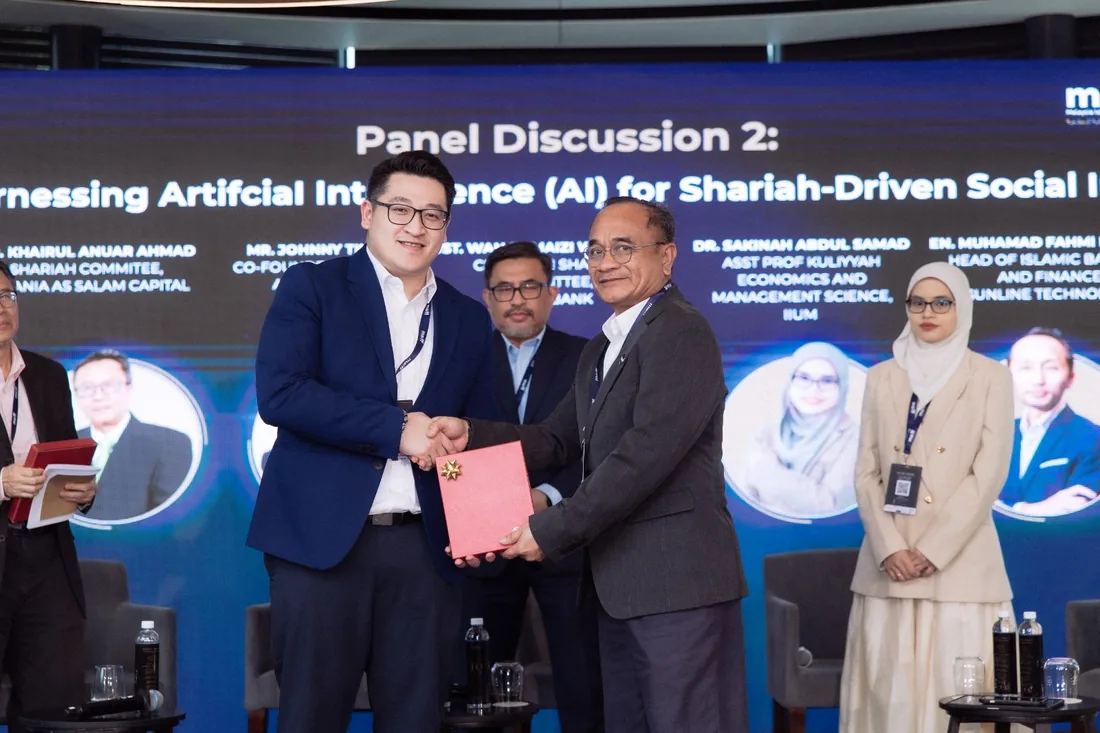
At the Sedania-organised Malaysia Islamic Fintech Forum, Arkmind CEO Johnny Tin spoke on AI in Shariah compliance and faster Shariah-compliant digital lending.
Islamic financing carries a compliance burden conventional lending does not. Every product has to satisfy Shariah principles, and every contract has to pass review before it reaches a customer. Done by hand, this review is slow. AI in Shariah compliance offers a way to keep the rigour while removing much of the delay.
Sedania organised the Malaysia Islamic Fintech Forum to bring the industry together on questions like this. Arkmind’s CEO, Johnny Tin, was invited to speak as one of the forum’s speakers, on the role of AI in Shariah compliance.
This article shares the thinking behind the talk: how AI supports Shariah compliance, where it fits in Islamic financing, and how Arkmind equips lenders to deliver Shariah-compliant digital lending faster.
What you will find below:
- How AI supports Shariah compliance without lowering the standard
- Why Shariah review slows down Islamic lending
- Where AI adds the most value in Islamic financing
- How Arkmind expedites Shariah-compliant digital lending
How does AI support Shariah compliance?
AI supports Shariah compliance by handling the repetitive checks a human scholar would otherwise do by hand. It reads contracts, flags terms conflicting with Shariah principles, and surfaces only the cases needing human judgement. The scholar stays in control of the decision. The machine removes the manual load.
This keeps the authority where it belongs, with the Shariah board, while cutting the time each review takes. Speed comes from automation, not from skipping steps.
Why Shariah compliance slows digital lending
A conventional loan moves from application to approval on credit checks alone. An Islamic facility adds another layer. The structure has to avoid riba, or interest. It has to steer clear of excessive uncertainty, or gharar. And the underlying contract, often a form of Tawarruq or commodity murabahah, has to be documented and executed in the right order.
Each of these is a checkpoint. On paper, a scholar or compliance officer reviews them one by one, and the customer waits. The more volume a lender handles, the longer the queue grows. Compliance is essential, but the manual process behind it is where the delay lives.
Where AI helps in Islamic financing
AI fits the parts of Islamic financing involving repetitive, rule-based work.
Document review. A model reads a contract and checks it against a library of approved structures, flagging anything off-template in seconds.
Product structuring. As a lender designs a facility, AI checks the terms against Shariah parameters before it reaches the board, so fewer cases bounce back.
Ongoing monitoring. Compliance does not end at signing. AI watches transactions over the life of a facility and raises any drift from the approved structure.
Audit and reporting. Every check leaves a record, so a Shariah audit reads from a clean trail instead of reconstructing one.
Does AI replace the Shariah scholar?
No. AI handles volume, not judgement. A scholar still decides whether a structure is sound, interprets principle where a case is unclear, and signs off on every product. What changes is how the scholar spends their time.
Without automation, a scholar wades through routine contracts looking for the rare problem. With it, the routine cases arrive pre-checked, and the scholar focuses on the exceptions and the genuinely new structures. The standard holds, and the bottleneck moves. This is the shift Islamic finance needs to scale digitally, and it is the case Johnny Tin made at the forum.
How Arkmind equips lenders for Shariah-compliant digital lending
Arkmind builds the digital lending platform these checks run on. The same system handling onboarding, credit evaluation, and collection is built to carry Shariah-compliant products alongside conventional ones.
For an Islamic lender, this means a few things in practice. Product structures are configurable, so a Tawarruq facility follows its own defined flow. Contracts are generated, signed, and stored digitally, with eKYC and digital attestation built in. And every step writes to an audit trail a Shariah reviewer reads directly.
Layering AI on this foundation is the next step. Because the platform already holds clean, structured data on every facility, a compliance model has exactly what it needs to work. The same connected-data principle drives our AI tools for credit decisions, and it applies equally to Shariah compliance.
Faster compliance, fully digital
The point Johnny Tin brought to the forum is simple. Shariah compliance and speed are not opposites. With the right platform and AI in the right places, an Islamic lender keeps full rigour and still approves faster.
Arkmind is building toward exactly this: a digital lending platform equipped to expedite Shariah-compliant lending without cutting a single corner. For lenders pursuing a license, the same discipline runs through our KPKT Digital Lending License work.
If you are an Islamic lender weighing how AI fits your compliance process, get in touch.